Help Turtle and They Be Friend Again
How to Identify a Turtle
Turtles are amongst the most loved pets in the world and in that location are countless species of them from huge sea turtles to freshwater turtles and finally country turtles, also known every bit tortoises.
These turtles have a huge array of needs with dissimilar types of turtles having different needs. Turtles eat a broad diversity of foods and require a wide variety of environmental conditions to thrive.
Identifying one turtle from another is essential if you desire to care for them. Turtle identification will assist yous care for your turtle. You can always see a herp vet if yous are nonetheless unsure.
Quick Reference Section
Types of Turtles
Offset, let's expect at the types of turtles we take.
Freshwater Turtle

Most turtles you would come across are freshwater turtles. Freshwater turtles are mostly smaller as compared to other turtles. These turtles are mostly aquatic or semi-aquatic and spend most of their time in aquatic environments.
Apart from box turtles, which spend less time in the water, all other freshwater turtles spend nigh of their time in water. Some such as the Japanese pond turtle tin spend months at the bottom of a pond or stream.
Examples include snapping turtles, cooters, softshell turtles, sliders, box turtles, forest turtles, and map turtles.
Body of water Turtles

These can be found in the body of water. They are more often than not large turtles and are generally purely aquatic. They do come to shore to lay eggs. The about telling characteristic of this type of turtle is its flippers. Instead of feet, bounding main turtles have flippers.
Examples include leatherback bounding main turtles, hawksbill sea turtles, and Atlantic ridley sea turtles.
Land Tortoise

These are exclusively found on land. They take high domes, and their shells are more often than not heavier and less streamlined. Identify a tortoise by inspecting the anxiety. They accept curt, elephantine legs. When land tortoises motility, they walk on their toes.
Examples include Greek tortoises, Russian tortoises, Indian Star tortoises, and red-footed tortoises.
Follow These Steps to Identify a Turtle
If you take pet turtles, knowing how to place a turtle is a must. To best identify the turtle species, strictly follow the steps.
1. Place If The Turtle Is A Freshwater Turtle, A Tortoise Or A Bounding main Turtle.
- If the front limbs are flippers, and so this is a sea turtle. They are big and rare to come across equally they spend almost of their lives in the ocean. (Motion to department 15, which is a section on identifying sea turtles.)
- If the front end limbs are not flippers simply instead toes (be information technology webbed or not), and then the turtle is either a tortoise or a freshwater tortoise. (Motion on to the next section.)
- Tortoises walk on their toes while turtles walk on the flat of their anxiety. Turtles take flat feet while tortoises have elephant-like clawed anxiety.
ii. Audit The Plastron Shape
- If the turtle has a plastron which covers well-nigh of its underside, and a short tail which isn't saw-like then it isn't a snapping turtle. (Motion on to the next section to better identify it.)
- The common snapping turtle (Chelydra serpentina) has a minor cross-shaped plastron which covers just a tiny part of the underside. This plastron is about one-half of the beat. The snapping turtle is quite large turtles with carapace lengths of viii to xviii.5 inches. The snapping turtle also has a long saw-similar tail.
3. Inspect The Shell
- If the shell/carapace is pliable and soft and the snout is elongated, and then it is a softshell turtle.
- If the shell is hard, then it is not a softshell turtle. Motility on to the side by side section.
4. Inspect The Scutes On The Shell
Scutes embrace the turtle'due south shell. They are equanimous of keratin.
- If the turtle has 12 scutes, continue to section 6.
- If the turtle has eleven scutes, keep to section 5.
five. Inspect The Pectoral Scute On The Plastron
- If the pectoral scute is squarish, and in that location is visible skin between the scutes, so it is a musk turtle.
- If the pectoral scute is triangular, and there is no visible skin between the scutes, and then this is a mud turtle.
6. Audit The Feet
- If the toes are webbed, and the plastron isn't hinged, refer to the next section.
- The eastern box turtle has 12 scutes and elephant-like feet. The toes are not webbed and the plastron is hinged allowing the turtle to exist completely enclosed in its shell. The scientific proper noun of the eastern box turtle is Terrapene carolina carolina. Although, they are pond turtles, don't spend every bit much fourth dimension in h2o every bit compared to other freshwater turtles.
7. Inspect The Keel
- If the carapace of the turtle is not sculptured with a central keel consisting of a pyramidal pattern of grooves and ridges, then refer to the next department. Also, audit the tail of the turtle if it's a hatchling. If its tail is shorter than the carapace, definitely motion on to the adjacent section.
- The wood turtle (Glyptemys insculpta) has a carapace that is apartment and sculptured, its central ridge or keel is equanimous of a pyramidal pattern of grooves and ridges. The coloration of this turtle'due south plastron is yellow with blackness spots on the corners of the scutes underneath the turtle. The tail of the hatchling is every bit long equally its carapace.
eight. Audit The Length Of The Neck.
- If the head and neck tin stretch to be as long as or fifty-fifty longer than the plastron and then you lot take a chicken turtle (Deirochelys reticularia).
- If the stretched length of the cervix and caput is less than the length of the plastron, so it's not a chicken turtle.
9. Inspect The Carapace
- If the carapace has concentric grooves and chocolate-brown concentric circles on the scutes, and so it may be a terrapin, too known every bit the diamondback terrapin (Malaclemys terrapin). This species besides take several black spots on the soft grayish pare of the head, cervix, and legs.
- b. If the carapace features mentioned in (a) are not available and the kegs are stripped or without marks, refer to the next section.
10. Inspect The Carapace Over again
- If the carapace has a serrated edge and saw-similar vertebral keel information technology may but be a map turtle (Graptemys spp). The red-eared slider likewise has serrated edges. Motility on to section 13 to learn more.
- If the carapace is smooth rather than serrated, then information technology may be an Eastern Painted Turtle (Chrysemys picta picta), Spotted Turtle (Clemmys guttata), or a Bog Turtle (Glyptemys muhlenbergii). Motility on to department xi.
11. Inspect The Jaws
- If the jaw features mentioned are absent-minded and the carapace has spots instead refer to section 12.
- The eastern painted turtle has an upper jaw that is notched with pocket-size cusps on either side. Similarly, you volition notice carmine-orange lines that get across the carapace.
12. Inspect The Carapace In one case Once again
- If the turtle lacks a keel, has an orange patch underneath the eye, and has a black carapace with yellow or white spots then it may be a spotted turtle (Clemmys guttata).
- If the carapace has a keel and is brown without markings, this turtle may be a bog turtle. The bog turtle too has a red-orange spot pm the cervix and head.
13. Inspect The Head And Neck
- If the stripes on the cervix are fewer than 16, then it may be a slider or cooter. There are several sliders including the Cumberland slider, the Yellow-bellied Slider, and the red-eared slider. Movement to the next department to narrow down the type of cooter or slider you take.
- Map turtles (Graptemys spp) have stripes (over 15) on their head and neck also as a small yellowish patch behind their optics. They also accept lines on their carapace which resemble contours thus the proper noun Map turtle.
Identifying Sliders And Cooters
Sliders have a midpoint notch in the marginal scutes at the posterior.
Sliders
Cumberland Sliders

The Cumberland slider has an olive-green to brownish carapace with yellowish markings.
Yellow Bellied Sliders
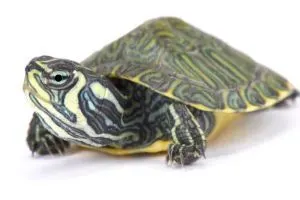
The yellow-bellied slider has a solid yellow plastron. Thus the name yellow-bellied.
Red-eared Sliders

Scarlet-eared sliders accept a blood-red patch backside their eyes. This looks like a scarlet ear.
Cooters
The cervix and head of cooters characteristic yellowish-white stripes and the marginal scutes of the posterior aren't notched midpoint.
Northern Cerise-Bellied Cooter

The northern scarlet-bellied cooter (Pseudemys rubriventris) has a red (or cherry-orange) plastron. The edges of the plastron are usually redder forming a carmine margin around the plastron. The carapace is brown or black with traversal yellow and orange stripes.
Eastern River Cooter

The eastern river cooter (Pseudemys concinna concinna) has a greenish-chocolate-brown with a 'c' mark that faces the posterior. It besides has about 11 or more stripes on the caput and necks. The plastron is reddish-orange to yellow with dark lines between the scutes that fade with historic period.
Coastal Evidently Cooter

The coastal plain cooter (Pseudemys concinna floridana) has x or fewer stripes on the head and neck. The plastron of this species is yellow and lacks any patterns.
Identifying Sea Turtles
Leatherback Ocean Turtle

If the sea turtle has no scutes, then information technology is a leatherback sea turtle (Dermochelys coriacea).
Kemp's Ridley Sea Turtle
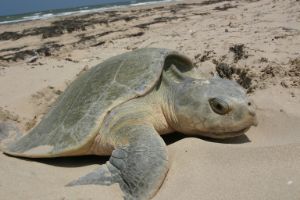
If the bounding main turtle has five pleural scutes and a squarish commencement vertebral scute with pores in its bridge scutes and 4 or five inframarginal scutes, it is the Atlantic ridley sea turtle (Lepidochelys kempii).
Green Bounding main Turtle

If the sea turtle has iv pleural scutes and a triangular start vertebral scute with i pair of prefrontal scales on its head and then it is the endangered black/green body of water turtle (Chelonia mydas).
Hawksbill Body of water Turtle

If the sea turtle has iv pleural scutes and a triangular start vertebral scute with two pairs of prefrontal scales on its head then information technology is the critically endangered hawksbill ocean turtle (Eretmochelys imbricata).
Loggerhead Bounding main Turtle

If the bounding main turtle has v pleural scutes and a squarish commencement vertebral scute with a large ovoid plate on its dorsum, and four or three inframarginal scutes on it bridge, then its a loggerhead bounding main turtle(Caretta caretta).
Identifying Land Tortoises
State tortoises different their aquatic cousins (turtles) prefer to dwell on land. Unlike turtles, tortoises aren't adapted to living in h2o. They are poor swimmers and have heavier shells.
Likewise, their anxiety are curt and sturdy instead of webbed similar about freshwater turtles. All of these characteristics make them better suited for the country.
There are several tortoise species in the world. Currently, there are virtually 50 tortoise species live. Hopefully, the number doesn't fall in the coming decades and even centuries. With so many tortoises alive, nosotros tin can't cover them all. We will be covering the nearly popular species.
Identifying A Spurred Tortoise And A Greek Tortoise

These tortoises have pointed scutes on their carapaces. These look similar spurs. They are almost 3 ft long and have brownish shells. As you can see, spurred tortoises are large. In the wild, they are owned to Sub Saharan Africa.

Greek tortoises (Testudo graeca) likewise accept pointed scutes on their carapaces. However, unlike the spurred tortoises, the Greek tortoises abound to be almost just 7 inches. Their shell is as well olive-green instead of brown.
Identifying A Russian Tortoise
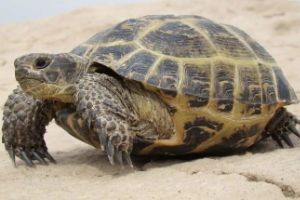
Russian tortoises are virtually 8 inches long. They take round shells and brownish-black scutes. The lines in-between their scutes are xanthous. This contrasts with their black coloration. Lookout out for the contrasting yellow and black coloration when identifying a Russian tortoise.
Identifying A Indian Star Tortoise

Indian tortoises take a star pattern on each of their carapace scutes. Their scutes are pointed with white/xanthous lines connecting the edges of the scute to the center. They are also about 8 inches long.
Identifying A Red-Footed Tortoise

The red-footed tortoise has ruby markings all over the feet. The ruby-red spots can likewise be found on the face. The carapace is black with yellow coloration. They are native to South American merely they are as well establish all over the world as pets. They are generally 11 to 14 inches long.
Identifying A Hermann's Tortoise

The easiest manner to place the Hermann'southward tortoise is to annotation the brown and yellow coloration. They are nearly 5 to seven inches long. Their beat is darkly colored with yellow lines in betwixt the scutes. In that location are xanthous spots all over their brownish skin.
Conclusion
Turtle identification is important. Information technology can be a difficult chore unless you know what you lot are doing. While nosotros are unable to provide a means to identify all 300 turtles currently living, we take provided identification methods for the virtually popular turtles in the earth.
Before nosotros leave you, we would like to remind you that sea turtles have flippers for limbs, freshwater turtles take apartment feet, and state tortoises have clawed elephantine feet.
I hope this commodity helps yous answer the question, 'What type of turtle do I have?' If you have any comments, kindly leave them. Thanks.
Source: https://www.allturtles.com/turtle-identification/
0 Response to "Help Turtle and They Be Friend Again"
Enregistrer un commentaire